Trichological Biophysics: Why Wet Hair Is Structurally Compromised
To understand why traditional stiff hairbrushes cause catastrophic damage to wet hair, one must analyze hair keratin biophysics. When hair is dry, its fibrous alpha-keratin polypeptide chains are stabilized by millions of hydrogen bonds, ionic salt bridges, and covalent disulfide bonds. Dry hair has high tensile strength.
However, water molecules (H2O) are polar: when hair is saturated under shower water, water molecules flood into the cortex, breaking the weak hydrogen bonds. In this state, hair keratin temporarily shifts from an alpha-helical conformation to a beta-sheet conformation. The hair shaft can stretch up to 30% to 50% beyond its original length. If a rigid, non-flexible brush encounters a knot in this vulnerable state, the hair stretches past its elastic limit, permanently deforming the cuticle and snapping off.
IntelliFlex Engineering: Why Bristle Flex Overcomes Knots
Standard hairbrushes feature rigid, unyielding plastic or metal bristles. When they hit a tangled cluster of hair, the rigid bristle exerts high kinetic force, pulling the knot tighter into a microscopic knot until the hair fibers snap under tension.
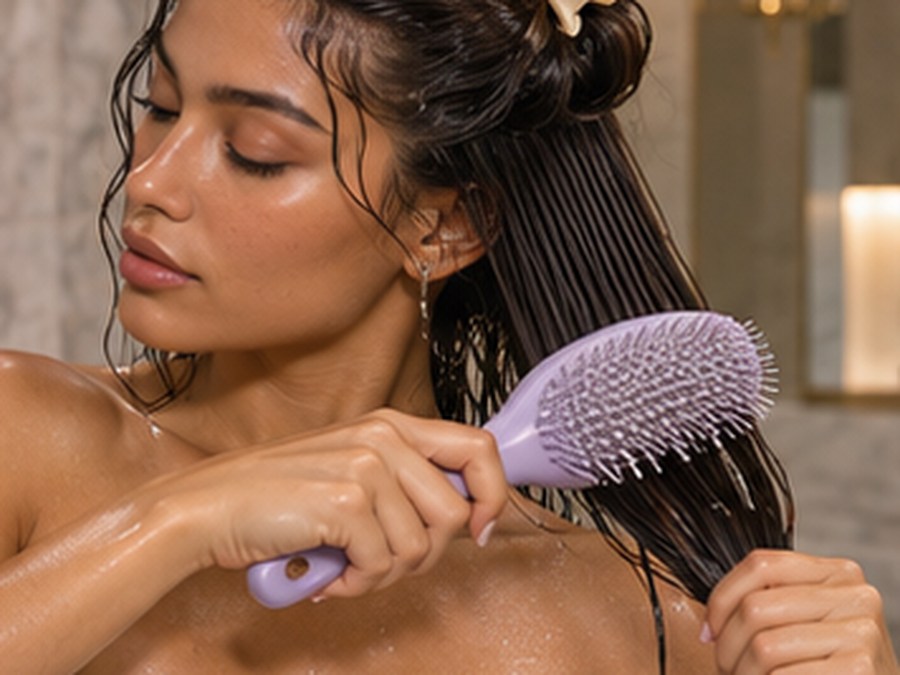
Dedicated wet detangling brushes (such as the Wet Brush and Tangle Teezer) are engineered with patented smart-memory elastomeric polymers (IntelliFlex). When the bristle meets resistance from a knot, it does not pull: instead, it flexes and bends backward, skipping gently over the knot. On subsequent passes, the flexible bristles tease the outer strands of the knot loose one by one, untangling the cluster without tearing a single hair fiber.
The Section-by-Section Bottom-Up Detangling Protocol
Even the most advanced wet brush will cause breakage if dragged directly from the scalp downward. The golden rule of detangling is the 'Bottom-Up Sectioning' methodology. Divide damp, conditioned hair into 4 manageable quadrants using non-creasing hair clips.
Hold the mid-lengths of the first section firmly with your non-dominant hand to buffer tension on the scalp. Begin brushing the bottom 2 inches of hair at the ends until completely smooth. Once the tips are free of knots, move up 2 inches higher. Working systematically upward in small sections prevents knots from sliding down and compounding into massive, impenetrable tangles at the ends.