Arkely's Top Selections
Carefully Vetted Formulations for Discerning Tastes
01 · Best overall Japanese sunscreen milk
Anessa Perfect UV Sunscreen Skincare Milk SPF 50+ PA++++
The benchmark in sun milks, featuring Auto Booster technology that becomes stronger with heat, humidity, and water while leaving an invisible silky-matte veil.
Best for: oily skin, high humidity, outdoor sports, and zero shine.
Check current price on Amazon
02 · Best weightless Korean water-gel sunscreen
Skin1004 Madagascar Centella Hyalu-Cica Water-Fit Sun Serum SPF 50+
Cult-favorite chemical sun gel infused with centella and hyaluronic acid that feels like a lightweight daily serum, leaving skin dewy with zero white cast.
Best for: normal, combination, and sensitive skin needing sheer hydration.
Check current price on Amazon
03 · Best matte fluid sunscreen for acne-prone skin
La Roche-Posay Anthelios Clear Skin Dry Touch Sunscreen SPF 60
Formulated with Perlite and Silica to absorb excess oil and sweat, delivering an all-day shine-free matte finish that will not clog pores or cause breakouts.
Best for: acne-prone skin, oily T-zones, and humid climates.
Check current price on Amazon
04 · Best rich lipid barrier sun cream for dry skin
EltaMD UV Restore Broad-Spectrum SPF 40 Sunscreen
Nourishing mineral sunscreen formulated with squalane, ginger root extract, and vitamins C and E to restore dry, mature skin barriers against photo-aging.
Best for: dry, mature, sensitive skin and post-laser recovery.
Check current price on Amazon
05 · Best sheer tinted fluid mineral sunscreen
SkinCeuticals Physical Fusion UV Defense SPF 50
Weightless mineral fluid featuring 100% physical filters and translucent color spheres that adapts to skin tone to boost radiance with zero white cast.
Best for: sheer universal tint, melasma protection, and all skin types.
Check current price on Amazon
Expert Technique & Theory
Formulation Science & Application Principles
The Formulation Rheology of Modern UV Vehicles
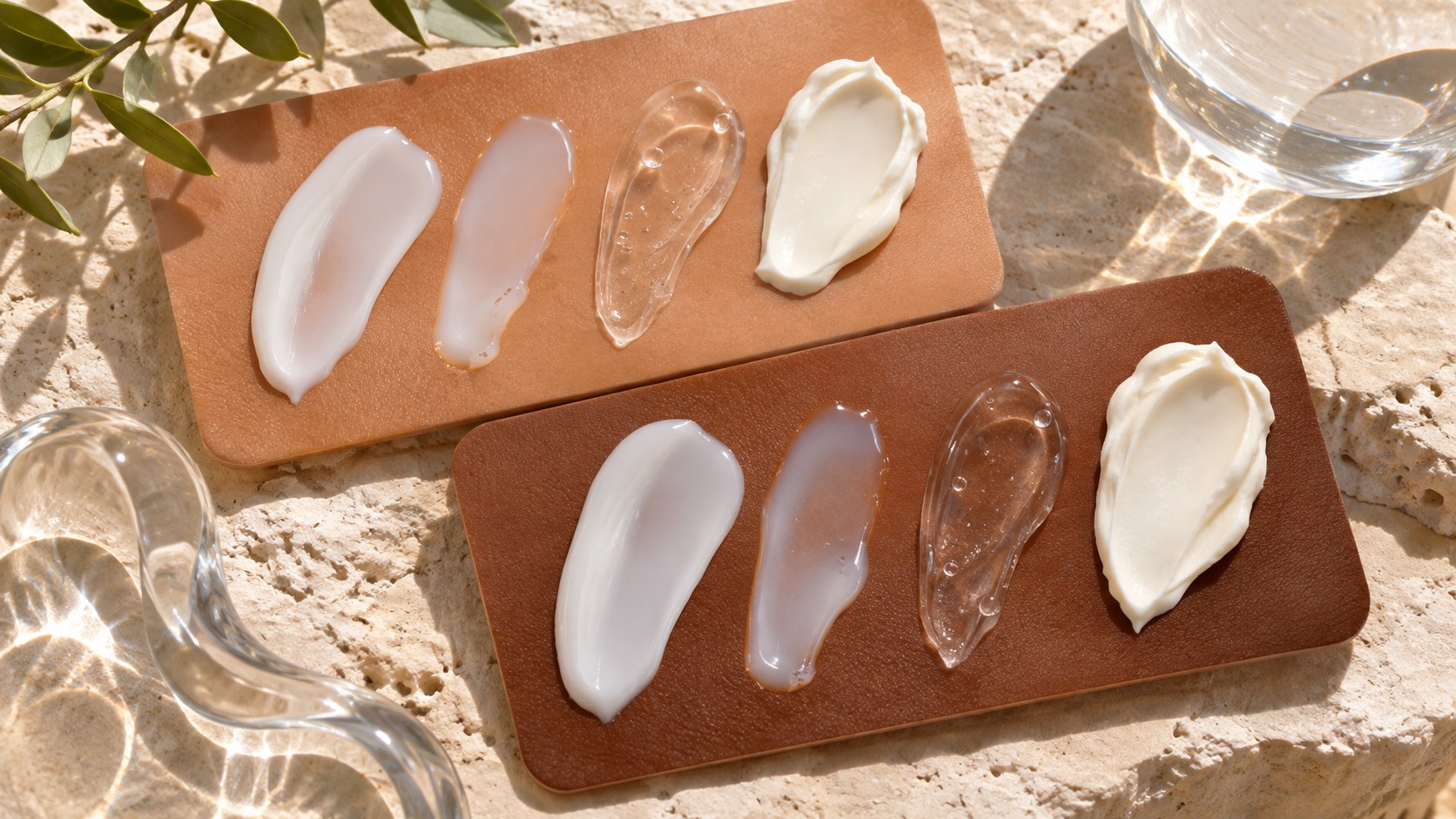
Sunscreen efficacy depends heavily on uniform film formation across the skin's microscopic peaks and valleys. Sunscreen milks utilize volatile silicones (such as cyclopentasiloxane) combined with hydrophobic spherical silica powders. Shaking the bottle activates these particles, which flash-evaporate upon application, leaving an ultra-thin, sweat-resistant film that controls oil.
Water-gel sunscreens use cross-linked acrylic polymers holding micro-capsules of organic UV filters. When rubbed onto skin, the polymer matrix ruptures, releasing a refreshing surge of water that hydrates the epidermis like a serum before setting into a clear, weightless veil.
Matching Vehicle Rheology to Transepidermal Lipid Output
Oily skin naturally produces high amounts of squalane and triglycerides. Applying a heavy cream SPF adds excess lipids that dissolve into sebum, creating a greasy shine and causing foundation to slide off.
Dry and mature skin has a deficient stratum corneum barrier with micro-cracks. Applying an alcohol-heavy sunscreen milk can draw out residual moisture, causing flaking. Dry skin thrives with rich cream formulations that combine UV filters with physiological lipids (squalane, ceramides) to lock in hydration all day.
Q&A Clarifications
Expert Guidance for Common Everyday Questions
What is the difference between a sunscreen milk and a sunscreen cream?
A sunscreen milk has a thin, watery consistency that you must shake before use; it contains volatile carriers that dry down to an ultra-light, powdery matte finish ideal for oily skin. A sunscreen cream is thicker, rich in moisturizing butters and oils, designed to nourish dry or mature skin.
Can a water-gel sunscreen replace my morning moisturizer?
Yes! For normal, combination, or oily skin, modern hydrating sun gels (like Skin1004 Hyalu-Cica) contain enough hyaluronic acid, glycerin, and centella to serve as both your morning hydrating serum and your SPF 50 defense in one step.
Why do some sunscreens pill into little white balls under makeup?
Pilling occurs when the polymers or silicones in your sunscreen clash with the base of your moisturizer or foundation (e.g., layering a heavy silicone foundation over an unabsorbed water-based gel). Allow your moisturizer to absorb for 2 minutes before applying SPF, and let SPF set for 3 minutes before makeup.