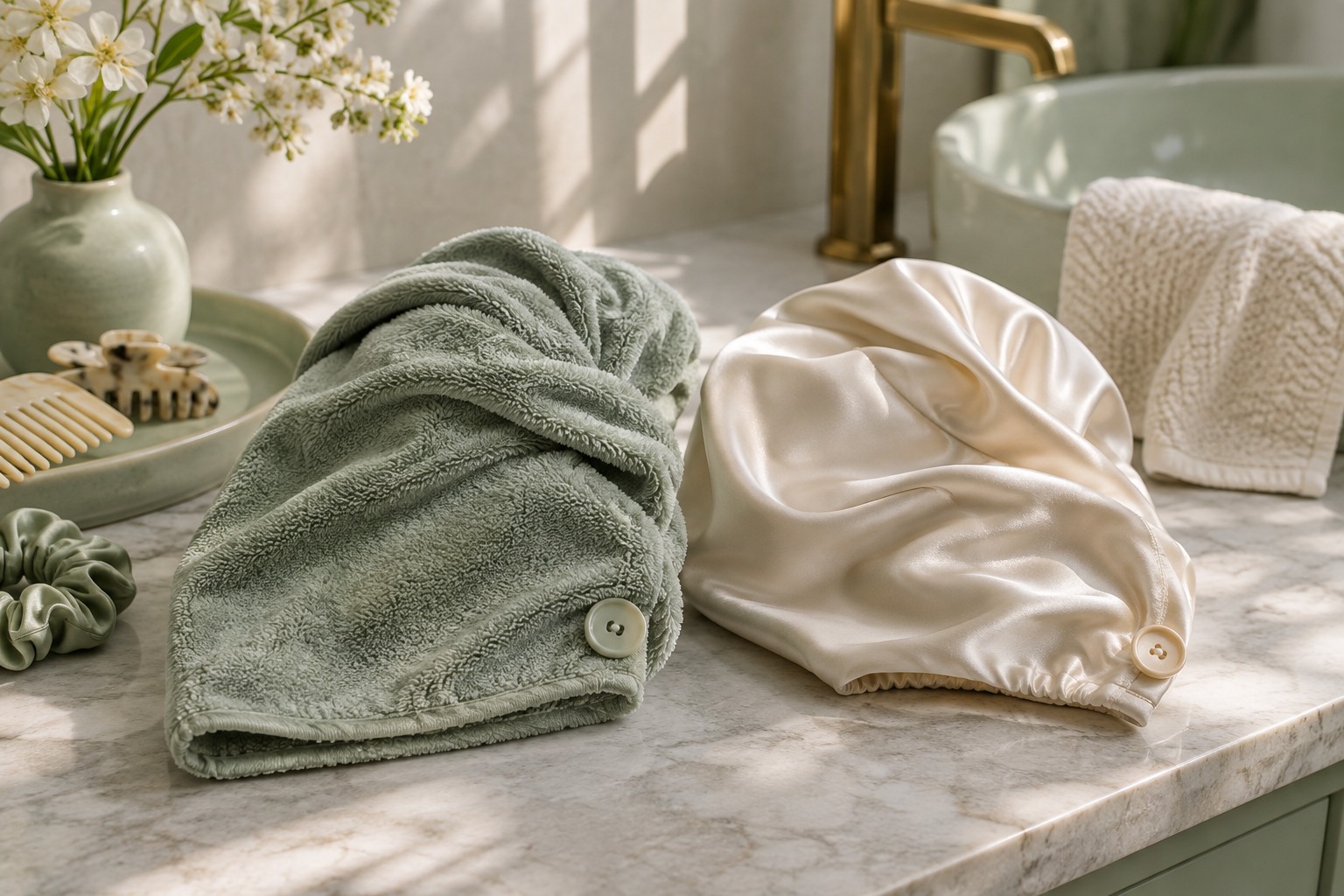
Textile Capillarity vs. Low Friction Co-Efficients
To optimize post-wash hair health, you must pair the right textile with the right moisture phase: 1. The Wet Phase (Water Removal): When hair is wet, water breaks weak hydrogen bonds, swelling the cortex and leaving the cuticle shingles flexible and vulnerable to mechanical fracture. Standard cotton terrycloth towels have large, looped yarn fibers that snag on these shingles, ripping cuticles and causing halo frizz.
Split-microfiber towels contain microscopic synthetic fibers split 1/100th the thickness of a human hair. Through intense capillary action, microfiber pulls water out of the hair shaft 5 times faster than cotton without generating frictional shear. 2. The Dry Phase (Friction Elimination): Once hair is 90% dry, microfiber's job is done. Sleeping in microfiber will dehydrate the hair cortex; switch to smooth, non-absorbent 100% mulberry silk to eliminate nocturnal friction.
The 15-Minute Micro-Plopping Method
Leaving wet hair wrapped tightly in a turban for hours can trap moisture at the scalp, creating an anaerobic breeding ground for Malassezia yeast and scalp flaking.
The ideal method: wrap wet hair in your microfiber towel for exactly 15 to 20 minutes to absorb excess dripping water ('micro-plopping'). Remove the towel, apply your leave-in conditioner and styling protectants, and allow to air-dry or diffuse before tucking into your silk bonnet for sleep.