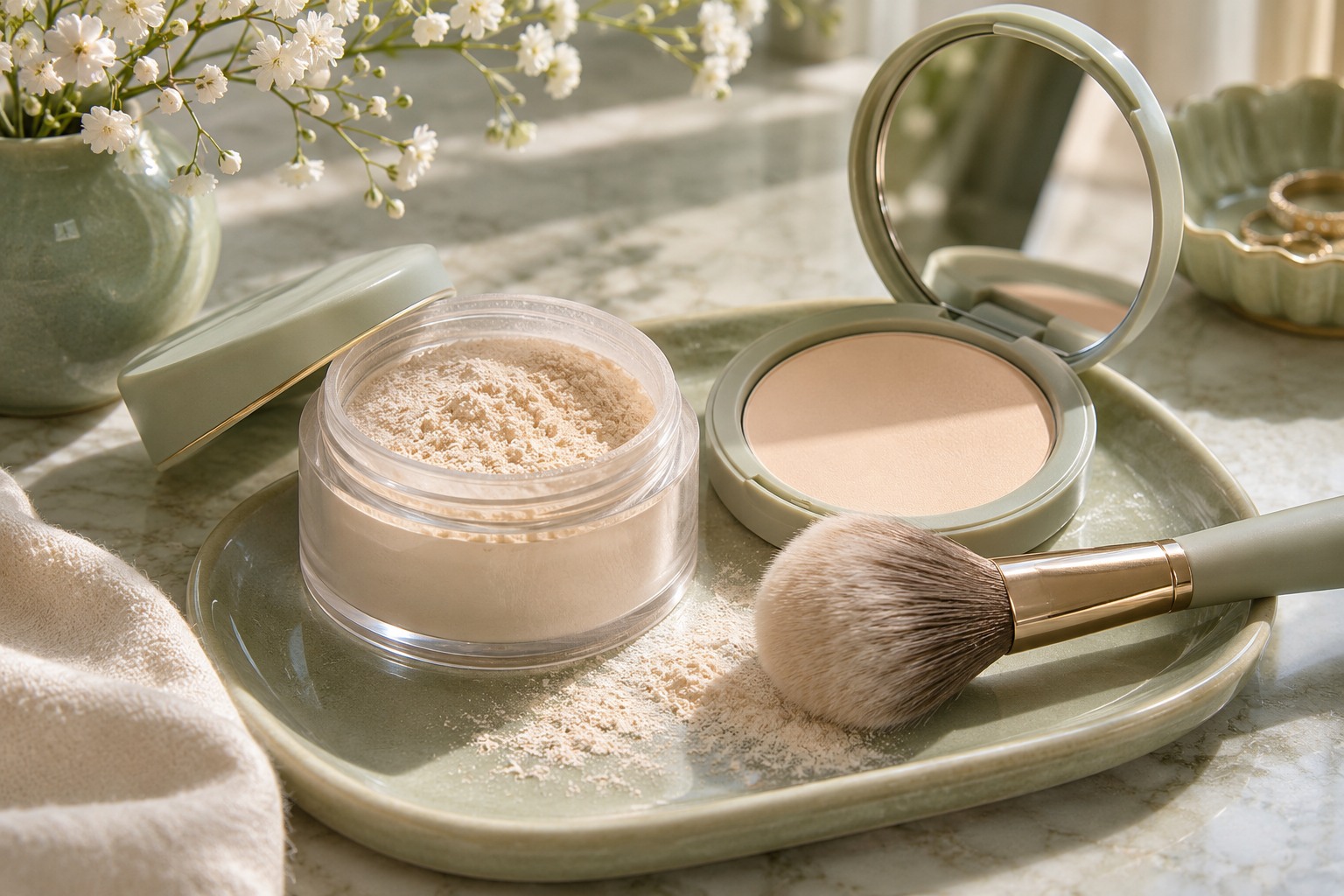
Formulation Science: The Role of Binders and Particle Size
To understand why loose and pressed powders behave differently on the skin, examine their manufacturing chemistry: 1. Loose Powders: Composed purely of micro-milled spherical particles of silica, talc, or cornstarch. Because loose powder contains zero liquid binders, each particle is completely free to absorb cutaneous sebum and perspiration. When pressed with a velvet puff, loose particles fill microscopic pore depressions, creating an optical soft-focus blur.
2. Pressed Powders: Loose mineral pigments cannot stay together in a metal pan without assistance; manufacturers must add 3% to 5% liquid binding agents (such as octyldodecyl stearoyl stearate, zinc stearate, or silicones) and press them under hydraulic pressure. These binders make pressed powders slightly more emollient, preventing them from looking chalky on dry skin, but slightly reducing their total oil absorption capacity.
The AM/PM Professional Powder Strategy
Celebrity makeup artists never rely on just one powder format. The optimal routine follows functional zoning:
Morning at Home: Use a loose translucent powder with a velour triangle puff to press and 'bake' the under-eye concealer and oily T-zone. This locks the liquid base against humidity for 12 hours. Daytime in Transit: Keep an ultra-milled pressed compact (like Charlotte Tilbury) in your handbag. When midday shine appears, lightly tap the pressed powder over the nose and chin to absorb oil without creating messy powder clouds in public.