The Ceramic Chemistry of Italian Terracotta Baking
Standard pressed eyeshadows are manufactured by mixing dry pigments with chemical liquid binders (oils and silicones) and compressing them into metal pans under hydraulic pressure. If water touches a traditionally pressed pan, the water-binding agents cross-link, creating a glass-like crust known as 'hard pan' that permanently prevents pigment pickup.
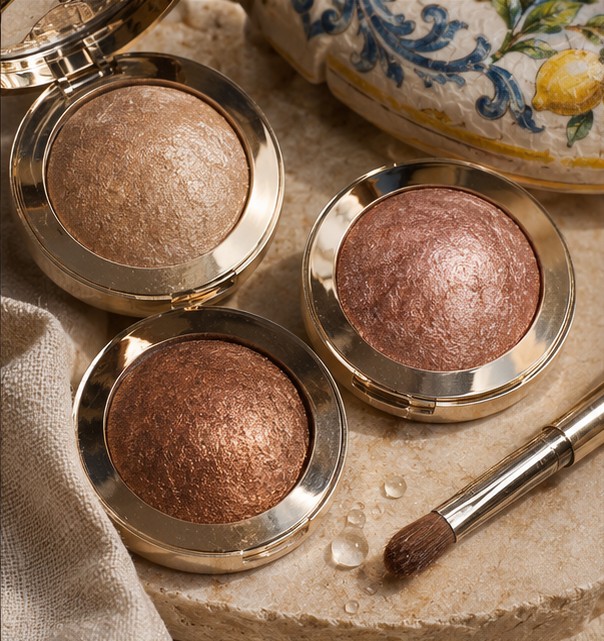
Italian baked eyeshadows (originating in the cosmetic hubs of Milan and Crema) start as creamy slurry emulsions poured directly onto porous terracotta clay tiles. Baked in temperature-controlled kilns for 24 hours, the moisture gently evaporates through the clay pores. This leaves behind a freestanding dome of pure pearl platelets free from heavy chemical binders, which can be repeatedly wetted without crusting.
The Physics of Refractive Index Matching in Wet Foiling
When applied dry, microscopic air pockets exist between the loose pearl particles on the skin, causing diffuse light scattering (a soft satin sheen).
When a brush is dampened with setting spray (water and glycerin) and touched to the baked dome, water displaces the air pockets. Because the refractive index of water (n = 1.33) is much closer to pearl platelets (n = 1.5–1.7) than air (n = 1.0), light refraction aligns into coherent specular reflection, producing the illusion of liquid molten metal.