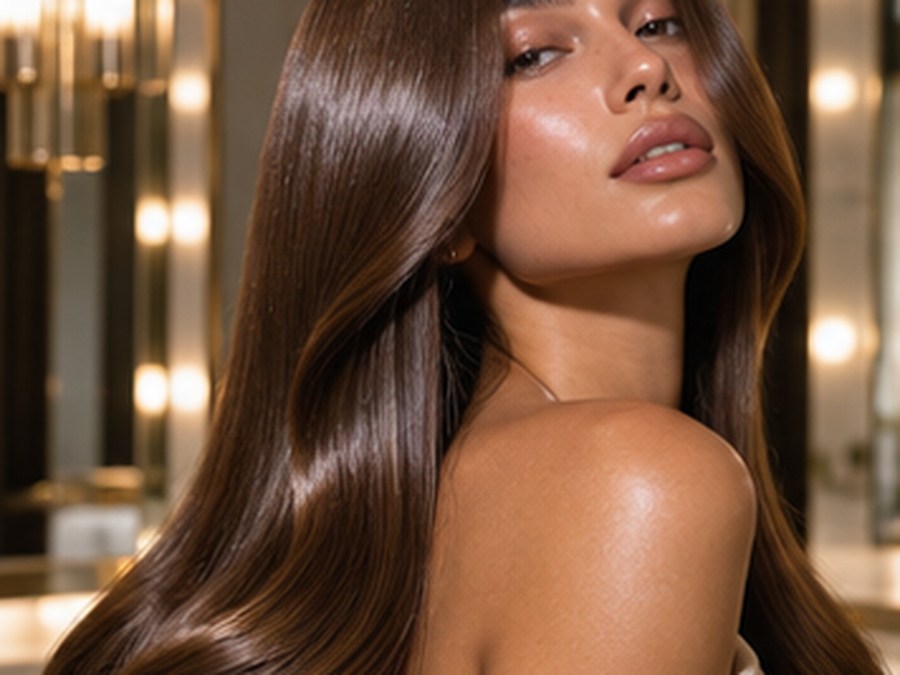
The Physics of Optical Reflection: Why Hair Appears Glass-Like
Light reflection is governed by Snell's law and Fresnel reflection. When the hair cuticle is dry, porous, or chemically lifted, light rays scatter in random directions, producing a dull, matte appearance. 'Glass hair' occurs when the microscopic cuticle shingles are compressed completely flat against the cortex, turning the strand into a specular reflector.
Heat-activated polymers (such as polysilicone-29 in Color Wow) contract as moisture evaporates under heat and mechanical tension. This shrinkage squeezes each hair fiber into a tight cylinder, wrapping it in an invisible hydrophobic film that prevents moisture vapor from entering and puffing up the cuticle.
Tension Blow-Drying: The Crucial Technique
You cannot achieve glass hair simply by spraying a glossy mist over air-dried hair. The heat-activated polymers require direct, continuous heat and strong downward tension.
Using a dense boar-bristle round brush, take 1-inch sections and direct the blow-dryer nozzle downward from roots to ends. Keep the nozzle 1 inch from the hair, pulling the brush firmly to align all cuticle layers before finishing with a cool-shot burst.